April 12, 2009
Cleverness
1 Comment
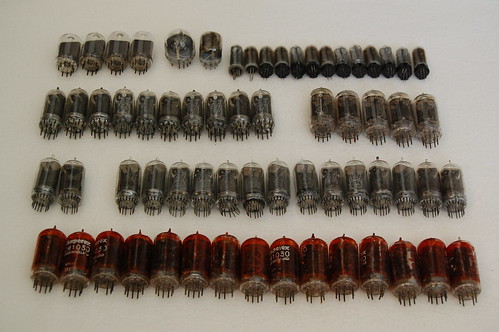
Recently I purchased a number of nixie tubes from the local electronics flea market:
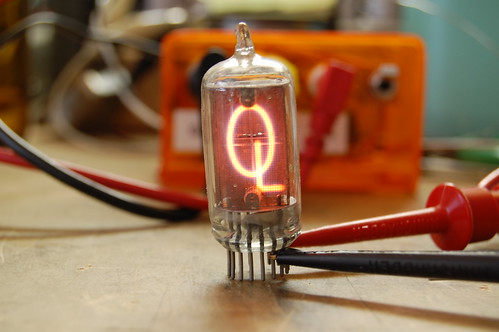
A few of them caught my eye. This Burroughs B-5448 one was most likely used in a calculator or possibly a meter to indicate plus and minus as well as the overload condition.
And this National NL-989 was used for indicating the unit or mode of a multimeter. There are two “partitions” in this nixie tube: one contains the symbols “A”, “M”, and “K”, while the other contains “C”, “V”, and “Ω”. The multimeter would have used this to indicate “AC”, “MV”, “KV”, “MΩ”, “KΩ”, and so on.
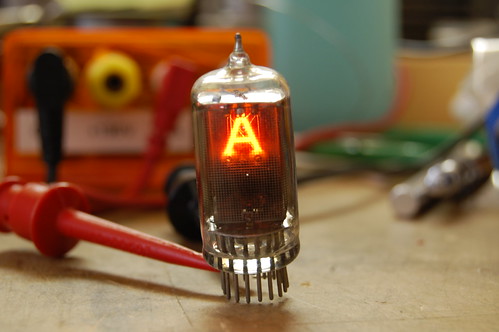
Notice how the glow is a different color in each tube? My camera did an excellent job of reproducing the correct color, so what you see is very close to what the ionized gas actually looks like. The National tube appears to contain mostly neon, while the Burroughs shows light blue “fringing”, indicating the presence of mercury, which was used to increase the lifespan of the tube.
April 12, 2009
Cleverness
No Comments
At the electronics flea market I found a rather interesting-looking vacuum tube. It appears to be a CRT but with a metal cap at the end.
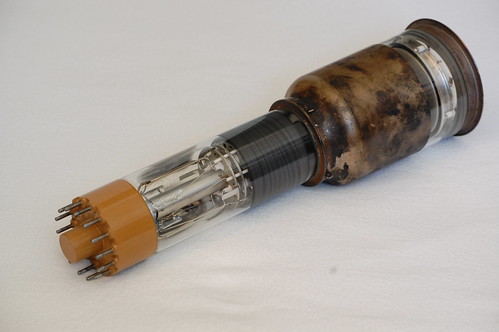
As it turns out, this device is a memory which could have been used in some old computers, storing around 16 kilobits. It could also have been used in radar systems for converting polar coordinate-based sweeps to raster sweeps (like a TV). The socket end contains an ordinary electron gun like the one found in a CRT, but the front end does not contain the usual phosphor screen. Instead, there is a 1mil thick sheet of mica with a fine grid of wires laid on top. On the other side of the mica there is a metal plate.
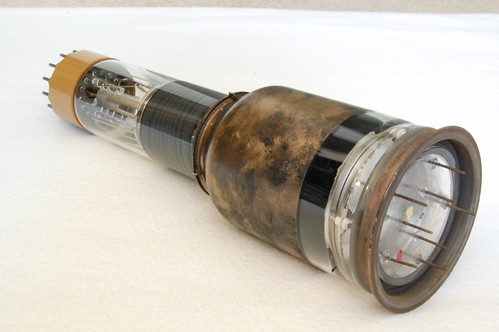
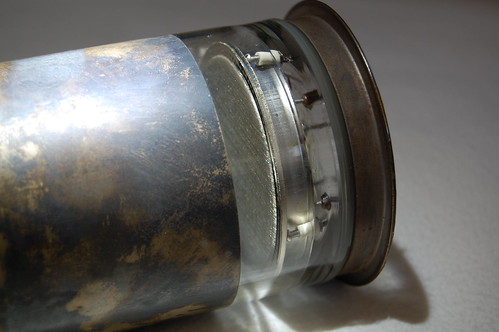
Here’s a closeup showing the metallic screen on the front. The mica underneath capacitively stores electrons that are laid down by the electron beam. This memory can store analog waveforms since higher voltages are represented by a higher density of electrons at a particular spot, and lower voltages correspond with a lower electron density.
Data for the tube is available from David Forbes.
Here are a couple of other sites with information:
Åke’s Tubedata
World Power Systems
Virtual Valve Museum
Cold War Infrastructure (A full-page RCA ad for the device)
January 7, 2009
Cleverness, Projects
21 Comments
In this previous post I disassembled the Coby DP-151SX digital picture frame. This device is very hackable, and includes a lot of goodies such as a Li-Ion battery and battery charger circuit as well as a neat little color LCD display with a white LED backlight. The pinout for the LCD is in the previous post.
The MAXQ2000 microcontroller development board I have uses a 0.1″ spacing header to connect to the I/O pins, so I made a little adapter and wired it up to the LCD connector using wire-wrap wire. It uses 13 I/O lines, but that could be reduced 11 if CS# is wired to ground and RST# tied to a separate reset IC (such as a MAX811). It’s actually a good idea to use CS#, because you can then multiplex the functionality of all the other pins and recover that I/O.
Here is a picture showing the LCD up and running with a simple test pattern:
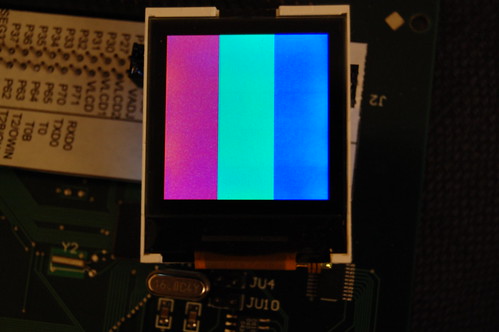
It’s not 128×128, but actually 132×132 pixels. The color depth is 16-bit using a fairly standard 5-6-5 bit encoding. See the PCF8833 datasheet for more details.
Spark Fun has a similar LCD display which uses the same controller, only it costs $20. Amazon.com sells the Coby-151SX in black for $10. Not a bad deal: for $10 less you get a Li-Ion battery, mini-USB cable, and a driver CD, which you could use as a coaster for your Mountain Dew to help with the LCD programming. Spark Fun has some sample code which you should easily be able to adapt for parallel mode (since the Coby LCD connector brings out the parallel data lines, unlike the Spark Fun LCD).
The source code for my test program will get posted once I clean it up and possibly add functionality (Character fonts? Bit blitters?)
December 1, 2008
Cleverness
No Comments
CNET’s Crave has a really fascinating post about a gentleman in Vietnam who has figured out how to unlock 3G iPhones–as of this writing, there is no software way to unlock this phone.
Unlocking iPhone 3Gs–the Vietnamese way
There are some interesting pictures showing some methods used by the Vietnamese technicians to remove and replace the flash memory device. They use a cheap hardware store heat gun, which is normally used to strip paint, to heat the solder until it melts, and then they remove it with tweezers. One of the problems with this sort of rework is that the adjacent components often loosen and shift or even fly off completely.
Look at the last picture in the article. The technician is using some small metal plates to protect the other components from the blast of hot air. Genius!
